The Wild Blueberries
There are two kinds of wild or lowbush blueberries to consider Vaccinium angustifolium and V.myrtilloides. In North America most are V. angustifolium Aiton, but V.myrtilloides also occurs in some area soften near or among V. angustifolium. Vaccinium angustifolium is known as sweet lowbush blueberries, though when it is being marketed it is called “wild blueberry” to avoid confusion with the cultivated highbush blueberries. It is a dwarf, woody, usually deciduous shrub that is found growing in a wide range of areas such as high moors, exposed rocky outcrops, abandoned pastures and bogs and among pine or oak trees. The soil pH where it grows ranges from 2.8 to 6.0 and may be peaty or sandy. It is a species that tolerates a wide range of temperatures.
Vaccinium angustifolium forms a spreading mat from underground rhizomes that can spread for up to 35 ft. Uprights 12 to 18 in. high grow at intervals from nodes on the horizontal rhizomes. The twigs bear elliptic or narrowly elliptic leaves that are ¼ to 2/3 in. wide to 2/3 to 16 in. long, usually with toothed or serrate margins. Their summer color is green, sometimes with a bluish or glaucous cast, and they change to a vivid red or orange in the fall before dropping. Flower bud initiation occurs in midsummer of the previous year with flower parts undergoing initial development with flower buds, which can be identified by end of August. The bud rest through the winter until activity starts inside them, unseen, as temperatures begin increasing in March. Active growth becomes obvious in April.
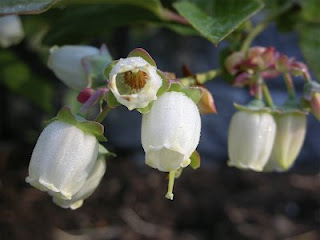
Bell shaped flowers are borne in loose clusters. They mature in May and are typically white, though sometime tinges pink. They are about ¼ in, long, with a glaucous or glabrous calyx and pedicel and very occasionally pubescent or covered with a soft down. The fruit, which is quite variable in color and size, may be a dull or glossy black, although those with a good bloom appear blue. The berries may be ¼ to ½ in. in diameter. They ripen from late July in southern Maine, with the last ripen occurring in late September in Newfoundland.
The Wild Blueberries


